
How Does Airflow Affect Coffee Roasting? A Practical Guide
When people talk about coffee roasting, they often focus on temperature, roast time, and the moment of first crack. But there is another important variable that can influence how a roast develops: airflow.
Inside a coffee roaster, moving air helps transfer heat, carries away smoke and moisture, and transports lightweight chaff away from the beans. The way airflow interacts with heat, drum movement, and roast timing can influence both the roasting process and the flavor of the finished coffee.
For coffee roasters, understanding airflow is not simply about opening or closing a damper. It is about learning how air movement works with the other controls on a particular machine.
What Is Airflow in Coffee Roasting?
Airflow refers to the movement of air through a coffee roasting machine. In many commercial drum roasters, a fan draws air through the roasting chamber and exhaust system. Depending on the machine design, the operator may adjust airflow using a damper, fan-speed control, or a combination of both.
As the air moves through the roaster, it interacts with the coffee beans and carries heat into and out of the roasting chamber.
Airflow also helps remove moisture released during roasting, smoke produced by thermal reactions, and chaff that separates from the beans.
The exact effect of an airflow adjustment depends on the roaster. Different machines have different drum designs, burners, fans, exhaust systems, and control settings. A setting that works well on one machine may not produce the same result on another.
How Airflow Transfers Heat to Coffee Beans
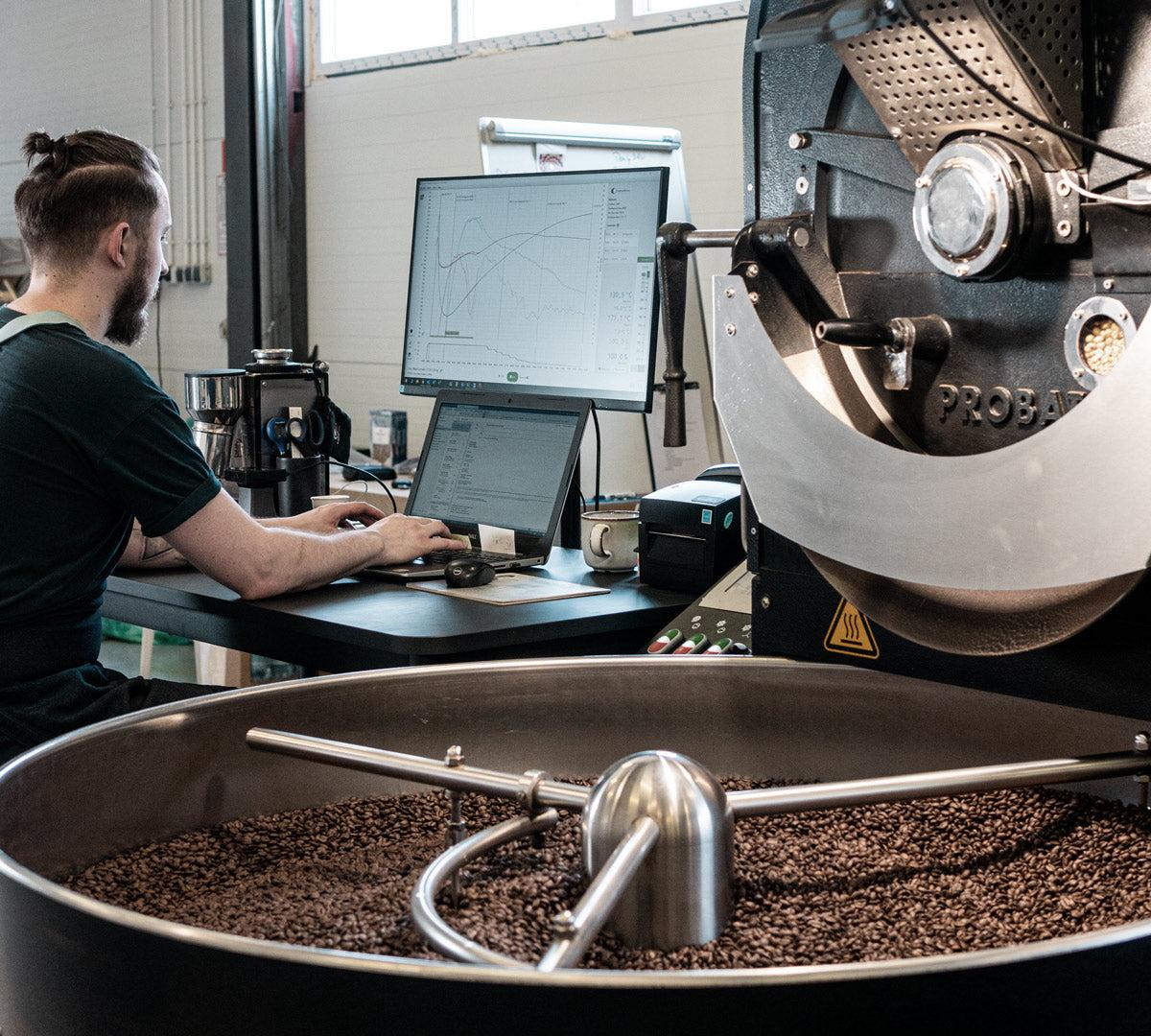
Heat reaches coffee beans through more than one mechanism.
Conduction occurs when beans come into contact with the hot surface of the roasting drum or with other heated materials.
Convection occurs when moving hot air transfers heat to the beans.
In many drum roasters, both mechanisms contribute to the roasting process. The balance depends on the machine's construction, operating conditions, and airflow settings.
Increasing airflow may improve the movement of hot air through the bean mass, but it can also change how much heat leaves the roasting chamber through the exhaust. Depending on the machine and the temperature of the incoming air, an adjustment may increase or decrease the heat delivered to the beans.
This is why airflow should not be treated as an independent temperature control. Its effect needs to be evaluated alongside burner power, drum temperature, bean temperature, and the overall roast profile.
Why Airflow Matters During Different Roast Stages
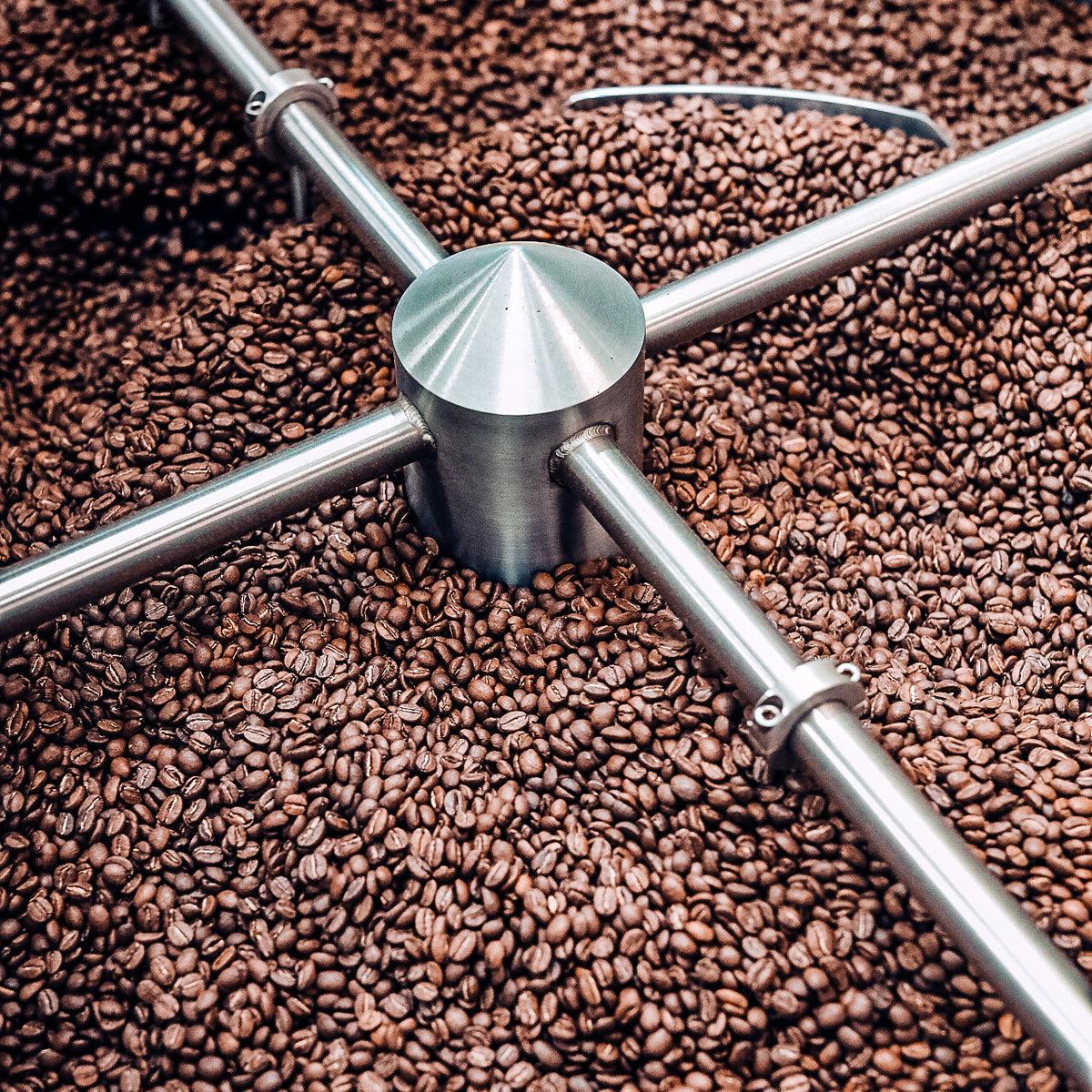
Airflow needs can change throughout a roast. However, there is no single damper setting that is correct for every coffee or roaster.
1. Drying Stage
During the early stage of roasting, green coffee beans release moisture as their internal temperature rises.
Air movement helps carry water vapor away from the roasting chamber. Adequate exhaust also supports the removal of unwanted moisture and byproducts from the process.
The goal is not to maximize airflow at all times. Excessive airflow may remove heat faster than intended, depending on the equipment, while insufficient airflow may limit effective exhaust.
Roasters should observe how changes affect the bean-temperature curve and the overall progression of the roast.
2. Maillard Reaction and Browning
As roasting continues, chemical reactions transform the beans' color and contribute to the development of aroma and flavor.
Airflow influences the transfer of heat and the removal of smoke and other volatile compounds. These effects can interact with the rate at which the beans develop.
If airflow changes the heat balance too dramatically, the roast may progress differently from the intended profile. A roaster should therefore evaluate airflow adjustments through repeatable test batches rather than relying on a universal rule.
3. First Crack and Development
First crack is an audible stage in which pressure inside the beans causes structural changes and cracking sounds. The period after first crack is often called development time.
During this phase, roasters carefully manage heat input and the rate of temperature change to achieve the desired roast character.
Airflow can affect heat transfer and exhaust conditions during development. Adjusting it may help manage smoke and the thermal environment, but the result depends on the machine and the coffee being roasted.
Rather than assuming that more airflow always creates a cleaner cup or that less airflow always produces more body, roasters should compare the resulting coffee through tasting and consistent roast records.
How Airflow Influences Smoke and Chaff Removal
Airflow has an important role beyond heat transfer.
As coffee roasts, thin layers of silverskin separate from the beans. This material is commonly called chaff. The roasting process also produces smoke and volatile compounds that need to be removed from the roasting chamber.
An effective exhaust path helps carry these materials away. Many commercial roasters use a cyclone or other collection system to separate chaff from the exhaust air.
Poorly maintained ducts, restricted exhaust paths, or unsuitable fan settings can interfere with ventilation. In some circumstances, smoke may escape into the roasting room or exhaust performance may become inconsistent.
Good airflow management therefore supports process control, workplace conditions, and equipment operation. Exhaust systems must be installed, inspected, and cleaned according to the roaster manufacturer's requirements and applicable fire-safety rules.
Does More Airflow Mean Better Coffee?
Not necessarily.
Increasing airflow can help remove smoke and moisture, but it may also carry heat away from the roasting chamber. Reducing airflow may retain more heat in some circumstances, but it can also limit smoke and chaff removal.
The outcome depends on several factors:
-
The design and capacity of the roaster
-
The batch size relative to machine capacity
-
The amount of heat supplied
-
The coffee's moisture content, density, and physical characteristics
-
The stage of roasting
-
The condition of the exhaust system
For example, changing airflow while keeping burner power constant may alter the temperature curve. If the roaster then compensates by changing gas or power, the final result reflects the combined adjustments rather than airflow alone.
This is why experienced roasters evaluate airflow in context. The objective is not to find the highest or lowest possible setting. It is to find a repeatable combination of heat, air movement, and time that produces the desired flavor.
How to Test Airflow Adjustments More Consistently
If you want to understand how airflow affects your roast, a structured testing process is more useful than changing several settings at once.
1. Establish a baseline. Choose a coffee and a familiar roast profile. Record the batch size, initial conditions, heat settings, airflow settings, turning point, first-crack timing, drop temperature, and total roast time.
2. Change one variable. Make a small airflow adjustment while keeping other conditions as consistent as possible. Remember that airflow and heat transfer interact, so the temperature curve may change even when burner settings remain the same.
3. Record the results. Compare temperature progression, roast duration, visible smoke, exhaust behavior, and the appearance of the roasted beans.
4. Taste the coffee. After allowing the samples to rest for a consistent period, compare aroma, sweetness, acidity, bitterness, body, and finish. Blind tasting can help reduce expectations from influencing your judgment.
5. Repeat the test. Repeatability matters. A single batch may be affected by differences in machine temperature, ambient conditions, batch size, or green coffee characteristics.
Keep notes for each batch so that successful adjustments can be reproduced. If your machine has roast logging software, use it to compare profiles and identify meaningful differences.
Why Airflow Matters for Roasting Consistency
Consistency is especially important when producing coffee for cafés, wholesale customers, or export orders. Buyers expect the coffee they receive to perform reliably from one batch to the next.
Airflow is one part of that consistency. So are green coffee quality, moisture content, batch size, machine condition, operator technique, and cooling after roasting.
Even when the same profile is used, differences in equipment conditions or incoming green coffee can affect the outcome. A reliable roasting process therefore combines documented settings with sensory evaluation and regular equipment maintenance.
At Cầu Đất Bean, we believe that understanding every stage—from the origin of the coffee to roasting and preparation—helps coffee professionals make better-informed decisions. For roasters exploring Vietnamese coffee, testing each lot with a consistent method is a practical way to understand its potential.
Frequently Asked Questions
Should airflow be increased during first crack?
There is no universal setting. The appropriate adjustment depends on the roaster, exhaust design, roast profile, and desired result. Follow the machine manufacturer's guidance and evaluate changes through controlled testing.
Can low airflow make coffee taste smoky?
Insufficient exhaust can allow smoke and other byproducts to remain in the roasting chamber longer than intended. However, smoky flavors can also result from roast conditions, equipment cleanliness, or other factors.
Does airflow affect roasting time?
Yes. Because airflow can change heat transfer and heat loss, it may affect how quickly the beans progress through a roast. The effect varies by machine and operating conditions.
Is airflow the same as burner power?
No. Burner power controls heat input in a gas-fired roaster, while airflow describes air movement through the machine. They interact, but they are not interchangeable controls.
Discover Vietnamese Coffee with Cầu Đạt Bean
Understanding roasting helps reveal the character of each coffee, but the starting material matters too. Explore Vietnamese coffee from the highlands of Đà Lạt and learn how origin, variety, processing, and roasting work together to shape the final cup.
CAU DAT BEAN
-
Showroom: 82B Trương Công Định, Phường Xuân Hương, Đà Lạt, Lâm Đồng, Vietnam
-
Phone / WhatsApp: +84 926 915 849
-
Email: caudatbean@gmail.com
-
Website: https://caudatcoffee.com.vn
Try before you buy.


 Group4, Cau Dat Village, Xuan Truong commune, Da Lat City, Lam Dong Province, Vietnam
 +84 783 472 234
 caudatbean@gmail.com
  www.caudatbean.com