
Why Coffee Sorting Matters: From Green Bean Defects to a Cleaner Cup
When we look at a bag of green coffee beans, it is easy to think that every bean is almost the same.
But coffee is an agricultural product.
Even within the same harvest, beans can vary in size, color, density, maturity, and physical condition. Some beans may contain defects or foreign material that can affect roasting consistency and, in some cases, the final cup.
This is why coffee sorting is an important part of green coffee quality control.
From small farms in Vietnam to professional coffee processing facilities, sorting helps producers and buyers create more consistent coffee lots before the beans reach the roaster.
What Is Coffee Sorting?
Coffee sorting is the process of separating coffee beans according to their physical characteristics.
The purpose is not simply to make the beans look more attractive.
Sorting helps remove or reduce unwanted materials and physical defects while creating a more consistent green coffee lot.
Depending on the production scale and quality requirements, sorting may include:
-
Removing foreign materials
-
Separating visibly defective beans
-
Removing broken or damaged beans
-
Separating beans by size
-
Separating beans by density
-
Identifying beans with unusual color or appearance
The exact sorting process can vary from one coffee producer to another.
Why Does Coffee Need to Be Sorted?
Coffee cherries do not develop under completely identical conditions.
During harvesting and processing, a coffee lot can naturally contain beans with different physical characteristics.
For example, a sample may contain:
-
Fully developed green beans
-
Immature beans
-
Broken beans
-
Insect-damaged beans
-
Discolored beans
-
Black or damaged beans
-
Foreign materials
Some defects are easier to identify visually than others.
This is why green coffee evaluation normally combines physical inspection with other measurements and, for professional buyers, sample roasting and cupping.
The Specialty Coffee Association includes physical assessment of green coffee as part of professional green coffee evaluation, including appearance, color, odor, defect count, bean size and shape, moisture, and water activity.
Hand Sorting: A Traditional Part of Vietnamese Coffee Production
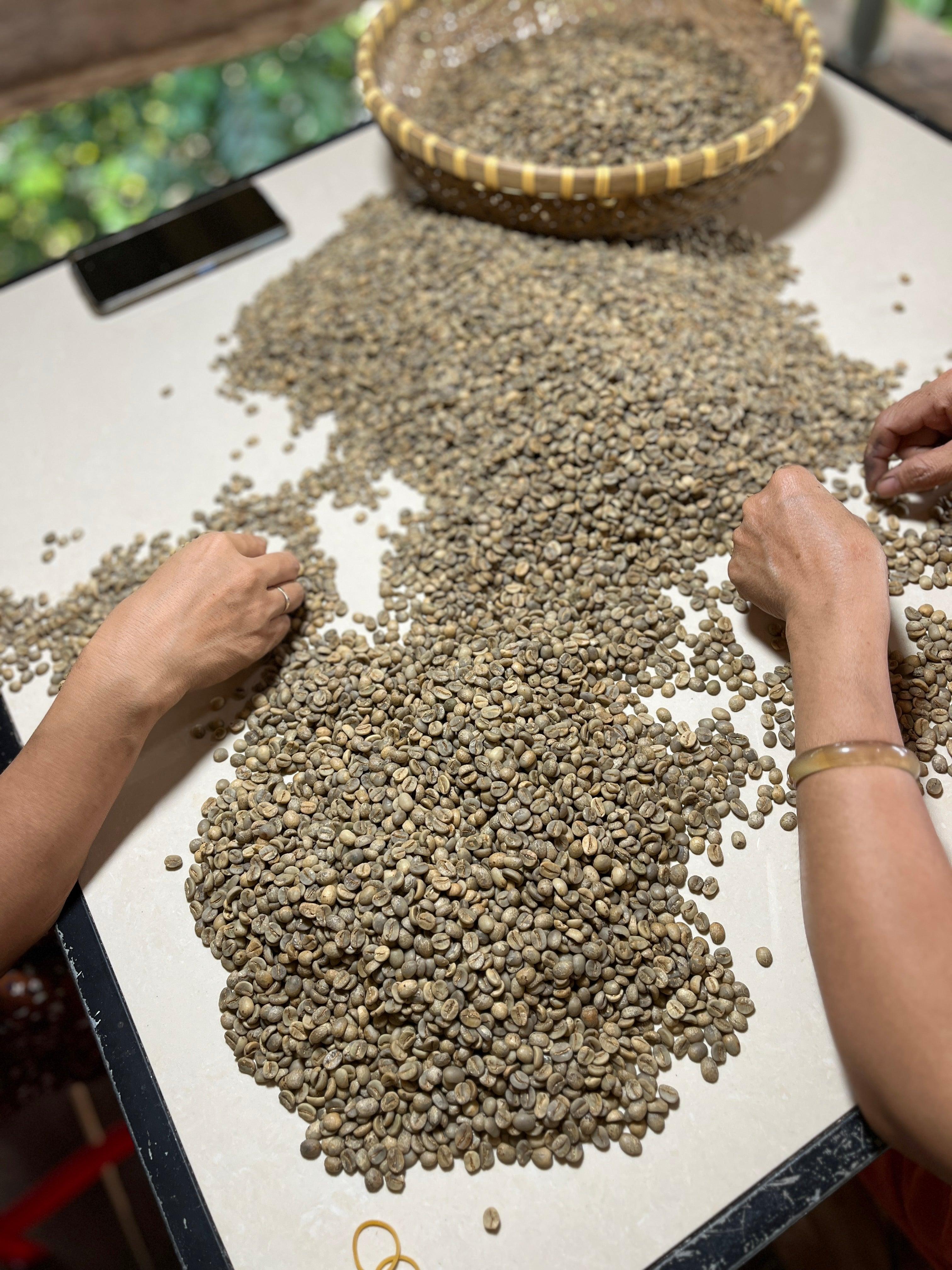
In Vietnam, hand sorting is still an important part of coffee production in many small-scale and quality-focused operations.
Workers can inspect the beans and remove unwanted pieces one by one.
It is a simple process, but it requires:
-
Time
-
Experience
-
Attention to detail
-
Consistent quality criteria
In highland coffee-growing areas such as Lâm Đồng and Đà Lạt, images of farmers and workers sorting green coffee by hand show an important part of the journey from farm to cup.
This human step is especially valuable when producers are working with smaller specialty lots where careful handling and quality control are important.
Sorting Is Not the Same as Grading
These two terms are sometimes used interchangeably, but they are not exactly the same.
Sorting generally refers to separating beans or materials based on specific physical characteristics.
Grading is a broader quality assessment that can involve several criteria, depending on the system being used.
For green coffee, professional evaluation may consider:
-
Bean size
-
Physical defects
-
Moisture
-
Water activity
-
Color
-
Shape
-
Odor
-
Processing method
-
Sample roast performance
-
Cup quality
SCA training materials specifically include identifying physical defects and grading coffee by size as part of green coffee evaluation.
Does Sorting Affect Roasting?
Yes, sorting can contribute to more consistent roasting.
Coffee beans with different physical characteristics may respond differently to heat.
For example, differences in:
-
Size
-
Density
-
Moisture
-
Physical condition
can influence how beans behave during roasting.
If a batch contains a large amount of unwanted variation, achieving a consistent roast can become more difficult.
This does not mean that every bean must be perfectly identical.
Instead, good sorting helps reduce unnecessary variation and allows the roaster to work with a more consistent raw material.
What Happens If Defective Beans Are Not Removed?
The effect depends on the type and quantity of defects.
One isolated defective bean may have little noticeable impact on a large batch.
However, a higher level of certain defects can affect:
-
Roasting consistency
-
Aroma
-
Flavor
-
Aftertaste
-
Overall cup quality
Research in the specialty coffee industry is continuing to investigate how physical green coffee defects relate to sensory quality. The Specialty Coffee Association has highlighted research into the sensory impact of physical defects in green coffee.
This is one reason professional coffee buyers do not evaluate green coffee only by appearance.
Size Sorting and Screen Size
Another important part of green coffee preparation is size separation.
Coffee beans are often classified using screen sizes.
For example, a lot may be described as:
Screen 16+
This means the coffee has been selected around a particular bean-size specification.
However, screen size does not tell the entire story about coffee quality.
Two coffees with similar screen sizes can still differ in:
-
Variety
-
Origin
-
Processing
-
Moisture
-
Density
-
Defect level
-
Cup profile
For buyers, screen size should therefore be considered together with other green coffee specifications.
Sorting Before and After Roasting
Sorting can happen at different stages.
Before Roasting
Green coffee can be inspected for visible defects and foreign materials.
This is particularly useful for removing beans that are clearly different from the rest of the lot.
During or After Roasting
Some issues become easier to identify after roasting.
For example, certain beans may roast differently and become visually distinct from the surrounding beans.
This is one reason sample roasting is so important when evaluating green coffee.
A green coffee sample may look promising, but roasting reveals how the beans actually behave under heat.
Why Sample Roasting Still Matters
Sorting improves physical consistency, but it cannot tell the whole story.
For professional buyers, a representative green coffee sample should ideally be evaluated through several steps:
Green coffee inspection → Sample roasting → Roasted bean inspection → Cupping
During cupping, buyers can evaluate characteristics such as:
-
Aroma
-
Flavor
-
Acidity
-
Sweetness
-
Body
-
Balance
-
Aftertaste
-
Defects or undesirable characteristics
This gives a much more complete picture of the coffee.
Coffee Sorting and Vietnamese Arabica
Vietnam is widely known for Robusta production, but highland regions such as Đà Lạt and Cầu Đất are also associated with Arabica cultivation.
Cầu Đất Arabica is grown at high elevations, where cooler conditions and slower cherry development can contribute to distinctive coffee characteristics. Cầu Đất Bean currently sources and supplies Arabica from the highlands of Đà Lạt, with lots evaluated according to their actual physical and sensory characteristics.
For Vietnamese Arabica, quality is not determined by origin alone.
A good lot still depends on:
-
Cherry maturity
-
Harvesting
-
Processing
-
Drying
-
Sorting
-
Storage
-
Roasting
-
Brewing
Every step matters.
What Should Coffee Buyers Look For?
When buying green coffee, sorting is only one part of the evaluation.
A practical checklist can include:
1. Origin
Know where the coffee was grown and whether the stated origin matches your purchasing requirements.
2. Variety
Ask whether the coffee is Arabica, Robusta, or a specific variety such as Catimor, Typica, or Yellow Bourbon.
3. Processing
Understand whether the coffee is washed, honey, natural, or processed using another method.
4. Moisture
Check the moisture specification and make sure it is suitable for storage and roasting.
5. Screen Size
Understand the size distribution of the lot.
6. Defects
Inspect the green beans and review the stated defect specifications.
7. Sample Roast
Always look at how the coffee behaves during roasting.
8. Cup Quality
Finally, taste the coffee.
The best purchasing decisions connect physical specifications with actual cup performance.
From Sorting Table to Coffee Cup
A cup of coffee may look simple when it reaches the table.
But before that moment, the beans have already gone through many stages.
Coffee cherry → Harvest → Processing → Drying → Sorting → Storage → Roasting → Brewing → Cup
Sorting may seem like a small step in this journey.
In reality, it is one of the practical quality-control steps that helps producers and roasters reduce unwanted variation before roasting.
For specialty coffee, quality is not created by one single action.
It is built step by step.
Final Thoughts
Coffee sorting is more than simply removing a few bad-looking beans.
It is part of a broader quality-control process that helps producers, exporters, buyers, and roasters work with more consistent green coffee.
Good sorting can help reduce unwanted physical variation, while sample roasting and cupping show how the coffee actually performs.
For Vietnamese coffee, especially highland Arabica from regions such as Cầu Đất and Đà Lạt, careful handling at every stage helps preserve the characteristics of the coffee from farm to cup.
At Cau Dat Bean, we believe that good coffee starts with understanding the green bean.
And sometimes, quality begins with something as simple as taking a closer look at each bean.
Visit Cau Dat Bean
If you are looking for Vietnamese green coffee, roasted coffee, or specialty Arabica from Đà Lạt, visit us in Da Lat and taste the coffee before making your decision.
📍 82B Truong Cong Dinh Street, Da Lat, Lam Dong, Vietnam
✨ Try before you buy
📞 +84 926 915 849


 Group4, Cau Dat Village, Xuan Truong commune, Da Lat City, Lam Dong Province, Vietnam
 +84 783 472 234
 caudatbean@gmail.com
  www.caudatbean.com