
What Is Coffee Channeling? Why Uneven Water Flow Changes Your Espresso
Have you ever made espresso that tastes both bitter and sour at the same time?
The problem may not always be the coffee beans.
It could be channeling.
Channeling happens when water finds easier paths through the coffee puck instead of flowing evenly through all the grounds. Some areas of the coffee may become over-extracted, while other areas remain under-extracted.
The result can be an espresso that tastes harsh, thin, sour, bitter, or simply unbalanced.
So, what causes coffee channeling, and how can you reduce it?
What Is Coffee Channeling?
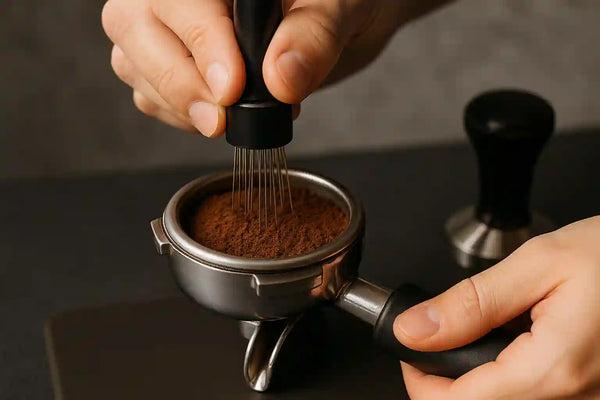
Coffee channeling is an uneven flow of brewing water through a bed of coffee grounds.
During espresso extraction, water is pushed through the coffee puck under pressure.
Ideally, water should move relatively evenly through the entire puck so that the coffee grounds contribute consistently to the extraction.
But if there are cracks, gaps, uneven density, or areas of resistance, water may choose the easiest route.
These small pathways are called channels.
Once a channel forms, more water can flow through that particular area, while other parts of the coffee puck receive less water.
This creates uneven extraction.
Why Does Channeling Affect Espresso Flavor?
Coffee extraction is about finding a balance.
Different compounds dissolve from coffee grounds at different rates. A well-prepared espresso aims to extract desirable flavors without excessively extracting unpleasant ones.
With channeling, this process becomes uneven.
Some coffee grounds may be exposed to too much water, while others receive too little.
This can create a confusing combination of flavors.
You may notice:
-
Sharp acidity
-
Harsh bitterness
-
Thin body
-
Weak sweetness
-
Astringency
-
Short or unpleasant aftertaste
This is one reason espresso can sometimes taste both sour and bitter.
The problem may not simply be “too fine” or “too coarse.”
The extraction may be uneven across the coffee puck.
What Causes Coffee Channeling?
Several factors can contribute to channeling.
1. Uneven Coffee Distribution
If the coffee grounds are not distributed evenly inside the portafilter, some areas may contain more coffee while others contain less.
Water naturally looks for areas where resistance is lower.
An uneven coffee bed can therefore encourage channel formation.
2. Clumps in the Coffee Grounds
Freshly ground coffee can sometimes form small clumps.
These clumps create differences in density throughout the puck.
When water reaches the coffee under pressure, it may find gaps between these areas rather than flowing evenly through the grounds.
3. Incorrect Grind Size
Grind size also plays an important role.
Coffee that is ground too fine can create very high resistance and slow down water flow.
Coffee that is too coarse may allow water to pass too quickly.
But the problem is not only whether the grind is fine or coarse.
Grind consistency matters too.
A grinder that produces a very uneven particle distribution can make it harder to create a uniform coffee puck.
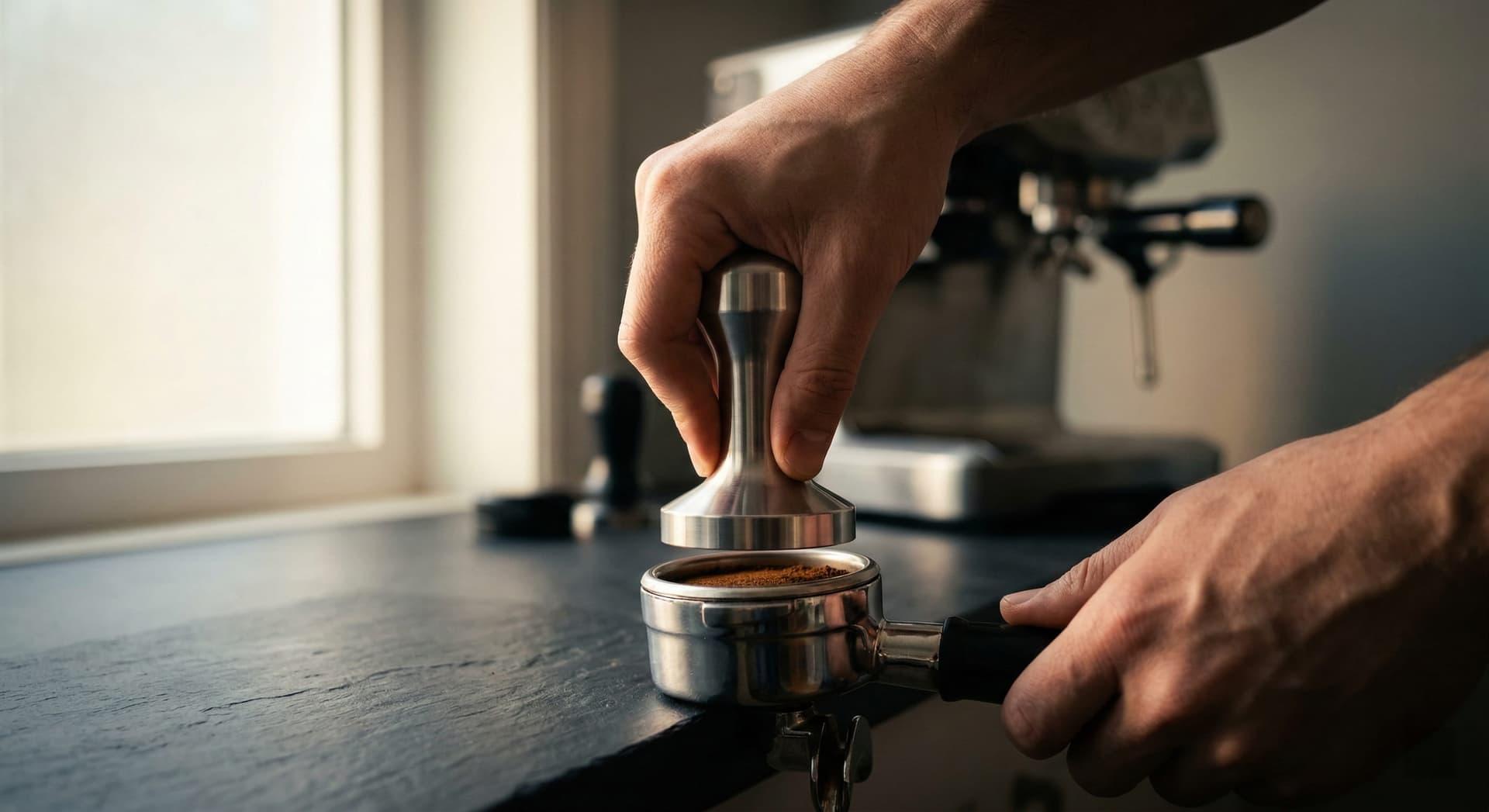
4. Poor Tamping
Tamping helps create a more even and compact coffee bed.
If the puck is tilted or compressed unevenly, some areas may offer less resistance than others.
Water can then favor these weaker areas.
However, tamping harder is not always the solution.
Consistency and evenness are generally more important than simply applying maximum pressure.
What Does Channeling Look Like?
Channeling is not always easy to see during extraction.
Sometimes the espresso appears to flow normally but still tastes unbalanced.
In other cases, you may notice:
-
Espresso coming from one side of the portafilter
-
Multiple thin streams
-
A sudden change in flow direction
-
Uneven flow from the espresso basket
-
A very fast extraction after an initially slow start
These signs can suggest that water is finding specific pathways through the coffee puck.
However, visual appearance alone cannot tell you exactly what is happening inside the puck.
Taste remains one of the most important indicators.
How Can You Reduce Coffee Channeling?
The good news is that several simple changes can help.
Improve Ground Coffee Distribution
Before tamping, try to distribute the grounds evenly across the basket.
Avoid having a large pile of coffee on one side.
Some espresso preparation techniques use tools or gentle distribution methods to break up clumps and create a more uniform coffee bed.
The goal is simple:
Create consistent resistance throughout the puck.
Use a Consistent Grind
A good espresso grinder is important because it helps produce a more predictable particle distribution.
If the grinder produces too many large particles and fines, controlling extraction becomes more difficult.
This is why espresso preparation often starts with the grinder rather than the espresso machine.
Tamp Evenly
Keep the tamper level with the coffee bed.
An angled tamp can create differences in puck density.
The objective is not necessarily to tamp as hard as possible.
Instead, aim for a level and consistent puck.
Check Your Dose
Using too much or too little coffee for the basket can also affect puck geometry and water flow.
A consistent dose makes it easier to repeat the same recipe and identify problems.
When adjusting espresso, change one variable at a time whenever possible.
Can Fresh Coffee Cause Channeling?
Freshly roasted coffee contains carbon dioxide produced during roasting.
As coffee rests, it gradually releases this gas through a process known as degassing.
Very fresh coffee can sometimes behave differently during brewing because of the amount of gas still present in the grounds.
This does not mean fresh coffee is bad.
It simply means espresso recipes may need adjustment as the coffee changes during the days after roasting.
Grind size, dose, and extraction time may need to be adjusted to maintain consistency.
Does Coffee Origin Affect Channeling?
Coffee origin does not directly cause channeling.
However, different coffees can behave differently during espresso preparation.
Factors such as:
-
Variety
-
Processing method
-
Roast level
-
Bean density
-
Moisture
-
Age after roasting
can influence grinding and extraction behavior.
For example, a light-roasted specialty Arabica may require a different grinder setting and extraction approach from a darker roasted coffee.
This is why espresso recipes should not be treated as universal formulas.
The same recipe may work beautifully for one coffee and poorly for another.
Coffee Channeling and Cầu Đất Arabica
Cầu Đất Arabica is known for its highland growing environment around Đà Lạt, where altitude, climate, variety, and processing all contribute to the characteristics of the coffee.
When using specialty Arabica for espresso, the goal is not simply to extract as much as possible.
The goal is to achieve a balanced extraction that allows sweetness, acidity, aroma, and body to work together.
Good preparation therefore matters just as much as the quality of the beans.
A high-quality coffee can still produce a disappointing espresso if the puck is poorly prepared.
Is Channeling Only an Espresso Problem?
Channeling is most commonly discussed in espresso because espresso uses pressure to push water through a compact coffee puck.
However, uneven water flow can also occur in other brewing methods.
Pour-over brewing, for example, can develop uneven flow if the coffee bed is disturbed or if water repeatedly follows the same pathway.
The mechanisms are different, but the principle is similar:
Water tends to move through areas where resistance is lower.
Understanding this principle can help coffee brewers improve consistency across different brewing methods.
A Simple Espresso Preparation Checklist
If your espresso tastes inconsistent, check these steps:
1. Grind:
Is the grind appropriate and reasonably consistent?
2. Dose:
Are you using the same amount of coffee each time?
3. Distribution:
Are the grounds spread evenly in the basket?
4. Tamping:
Is the coffee puck level and evenly compressed?
5. Extraction:
Does the espresso flow reasonably evenly?
6. Taste:
Is the final cup sweet, balanced, and pleasant?
Changing several variables at once can make troubleshooting difficult.
Instead, adjust one factor at a time and compare the results.
Final Thoughts
Coffee channeling is a good reminder that espresso quality depends on more than the coffee bean itself.
Grind consistency, distribution, dose, tamping, and extraction all work together.
When water flows evenly through the coffee puck, you have a better chance of achieving a balanced extraction.
When water finds easy pathways, some parts of the coffee may be over-extracted while others remain under-extracted.
So the next time your espresso tastes strangely sour, bitter, or unbalanced, don't immediately blame the beans.
Take a closer look at the puck.
Sometimes, the real problem is simply where the water is going.
Discover Cầu Đất Coffee
At Cầu Đất Bean, we offer Vietnamese coffee selections suitable for different brewing styles, including Arabica from the highlands of Đà Lạt.
Try before you buy.
📍 Showroom: 82B Trương Công Định, Phường Xuân Hương, Đà Lạt, Lâm Đồng, Vietnam
📞 Phone / WhatsApp: +84 926 915 849
📧 Email: caudatbean@gmail.com
Frequently Asked Questions
What is coffee channeling?
Coffee channeling occurs when water finds uneven pathways through coffee grounds instead of flowing consistently through the entire coffee puck.
Why does channeling make espresso taste bad?
Because different parts of the coffee puck can become extracted at different rates, creating an unbalanced combination of sour, bitter, harsh, or weak flavors.
Does tamping harder prevent channeling?
Not necessarily. Even distribution and a level, consistent tamp are generally more important than simply increasing tamping pressure.
Can grind size cause channeling?
Yes. Incorrect or inconsistent grinding can create uneven resistance and make channeling more likely.
How can I reduce espresso channeling?
Focus on consistent grinding, even distribution, a level tamp, a consistent dose, and careful adjustment of your espresso recipe.


 Group4, Cau Dat Village, Xuan Truong commune, Da Lat City, Lam Dong Province, Vietnam
 +84 783 472 234
 caudatbean@gmail.com
  www.caudatbean.com