
What Is Coffee Brew Ratio? How Coffee-to-Water Ratio Changes Your Cup
Have you ever brewed coffee using the same beans, the same grinder, and the same brewing method, but the final cup still tasted completely different?
One of the simplest reasons could be the coffee-to-water ratio.
The brew ratio is one of the most important variables in coffee brewing. It determines how much coffee is used in relation to the amount of water and has a direct influence on the concentration, strength, and overall balance of the cup.
Understanding brew ratio can help both beginners and experienced coffee drinkers make more consistent coffee.
What Is Coffee Brew Ratio?
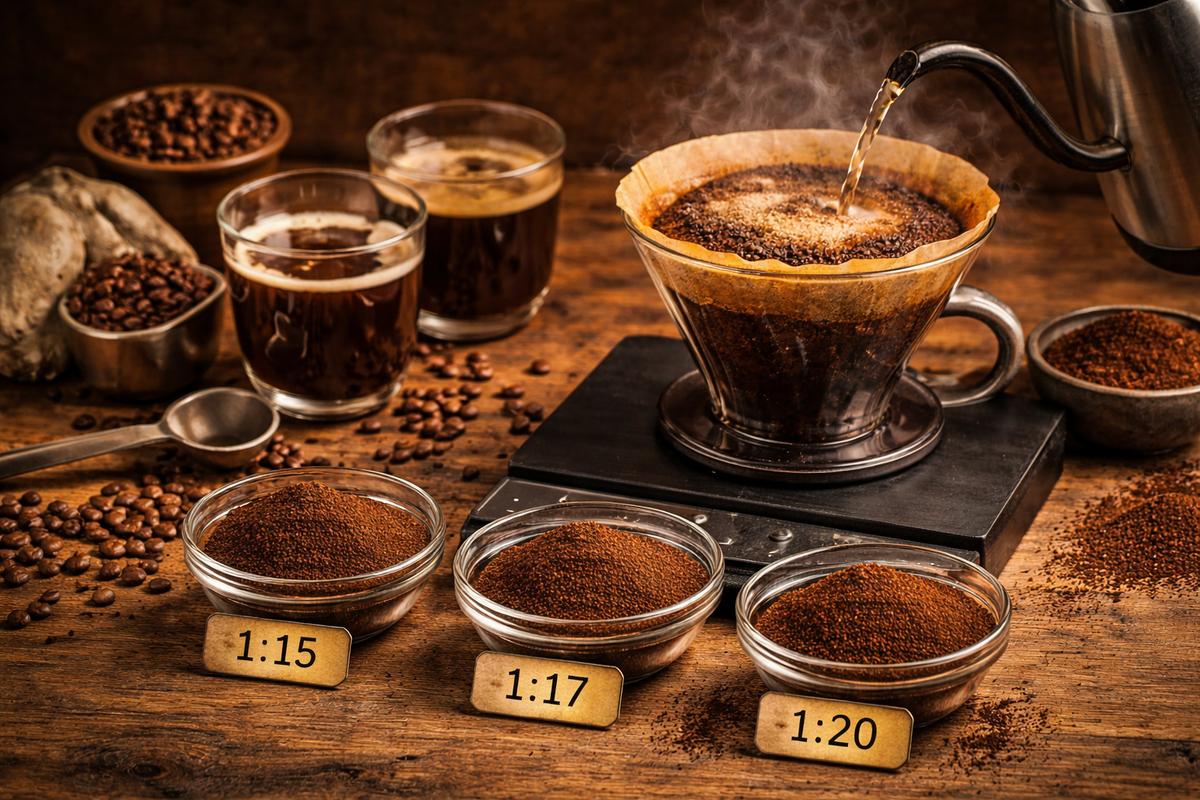
Coffee brew ratio describes the relationship between the amount of coffee and the amount of brewing water.
It is usually written in a simple format such as:
1:15
This means:
1 gram of coffee : 15 grams of water
For example:
-
10 g coffee + 150 g water = 1:15
-
20 g coffee + 300 g water = 1:15
-
30 g coffee + 450 g water = 1:15
The ratio stays the same even when the total batch size changes.
This makes brew ratio a practical way to scale a coffee recipe.
Why Does Brew Ratio Matter?
Water is the main ingredient in brewed coffee.
Changing the amount of water while keeping the coffee dose constant changes the concentration of the final beverage.
For example, imagine using 20 g of coffee.
With 300 g of water, the ratio is 1:15.
With 340 g of water, the ratio becomes approximately 1:17.
The second recipe uses more water with the same amount of coffee, so the resulting beverage will generally be more diluted.
On the other hand, using less water will generally create a more concentrated cup.
This is why a small change in the recipe can make a noticeable difference in taste.
Brew Ratio and Coffee Strength
Brew ratio is closely connected to coffee strength, but the two terms are not exactly the same.
A smaller amount of water relative to the coffee generally produces a more concentrated beverage.
A larger amount of water generally produces a less concentrated beverage.
For example:
1:15 Ratio
This uses relatively more coffee compared with water.
The resulting cup may feel stronger and more concentrated.
1:17 Ratio
This uses more water for the same amount of coffee.
The resulting cup may feel lighter and more delicate.
1:18 Ratio
This creates an even lower concentration and may produce a lighter style of brewed coffee.
However, ratio alone does not determine the final taste.
Grind size, brewing time, water temperature, coffee variety, roast level, and extraction all matter too.
Is There One Perfect Coffee Ratio?
No.
There is no single brew ratio that works perfectly for every coffee.
Different brewing methods and coffees can require different recipes.
A light roasted high-altitude Arabica may respond differently from a darker roasted Robusta.
A washed coffee may also behave differently from a natural or honey-processed coffee.
This is why brew ratio should be treated as a starting point rather than a strict rule.
The best ratio is the one that produces the flavor and concentration you want from a particular coffee.
Common Starting Ratios for Filter Coffee
For manual filter brewing, many coffee drinkers start somewhere around 1:15 to 1:17.
For example:
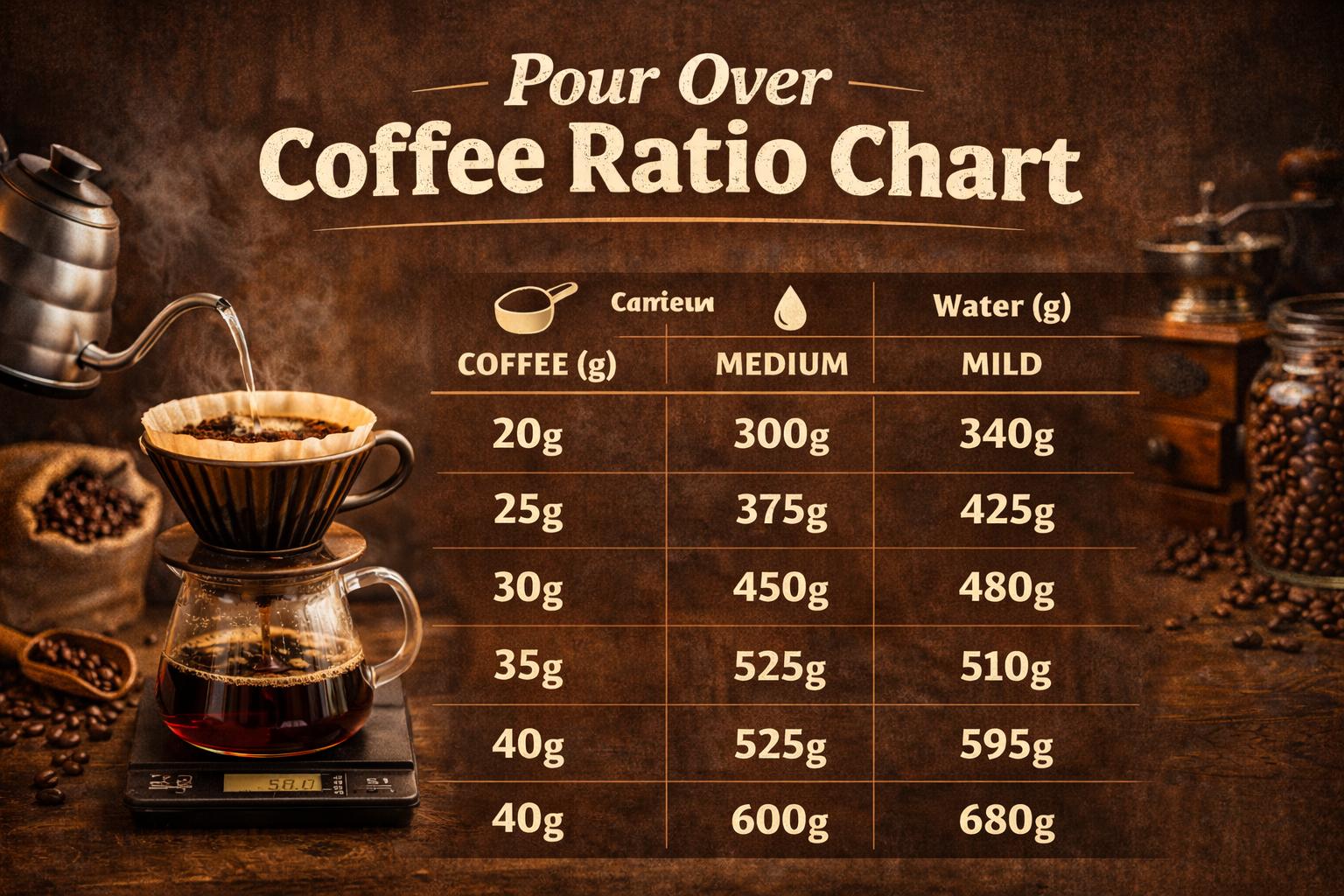
| Coffee | 1:15 | 1:16 | 1:17 |
|---|---|---|---|
| 15 g | 225 g water | 240 g water | 255 g water |
| 20 g | 300 g water | 320 g water | 340 g water |
| 25 g | 375 g water | 400 g water | 425 g water |
| 30 g | 450 g water | 480 g water | 510 g water |
These numbers are starting points, not universal standards.
Your coffee may taste better with a slightly stronger or weaker ratio.
What Happens When You Use Too Much Coffee?
Suppose you normally use 20 g of coffee with 320 g of water.
This is approximately a 1:16 ratio.
If you keep the water at 320 g but increase the coffee to 25 g, the ratio becomes approximately 1:12.8.
The beverage will generally become more concentrated.
Depending on the brewing process, it may also become harder to achieve the same extraction balance.
If the cup tastes heavy, intense, or lacks clarity, reducing the coffee dose may be one variable worth testing.
What Happens When You Use Too Much Water?
Now imagine using 20 g of coffee with 400 g of water.
The ratio becomes 1:20.
The beverage will generally be much more diluted.
The coffee may taste lighter and less intense.
However, a lighter cup is not automatically a bad cup.
Some coffees can work very well at a higher water ratio, particularly when you want more clarity and a delicate drinking experience.
The key is to adjust the recipe according to the coffee and your preferred flavor.
Brew Ratio vs. Extraction
Brew ratio and extraction are related, but they are not the same thing.
Brew ratio tells us how much coffee and water are used.
Extraction tells us how much soluble material is removed from the coffee grounds during brewing.
You can change the brew ratio without necessarily changing the extraction in the same way.
For example, using more water may make the beverage less concentrated, but it does not automatically mean that the coffee was extracted poorly.
This is an important distinction when adjusting a recipe.
If a coffee tastes weak, the solution is not always “use more coffee.”
Sometimes the real issue may be grind size, brewing time, water temperature, or extraction.
How Grind Size Works With Brew Ratio
Brew ratio should always be considered together with grind size.
A finer grind provides more surface area for water to interact with the coffee.
A coarser grind provides less surface area.
Imagine that you change your brew ratio from 1:16 to 1:15.
If the coffee becomes too intense, you may decide to adjust the grind or other brewing variables rather than simply returning to the original recipe.
This is why experienced brewers usually change one variable at a time.
It makes it easier to understand what caused the change in flavor.
How Water Temperature Affects the Recipe
Water temperature also influences extraction.
Hotter water generally extracts coffee more quickly.
Cooler water generally extracts more slowly.
Therefore, changing the brew ratio without considering temperature can sometimes produce unexpected results.
For example, if you increase the amount of water and also increase the brewing temperature, the coffee may behave very differently from simply adding more water.
A consistent brewing process makes it easier to compare different ratios.
Why a Coffee Scale Is Useful
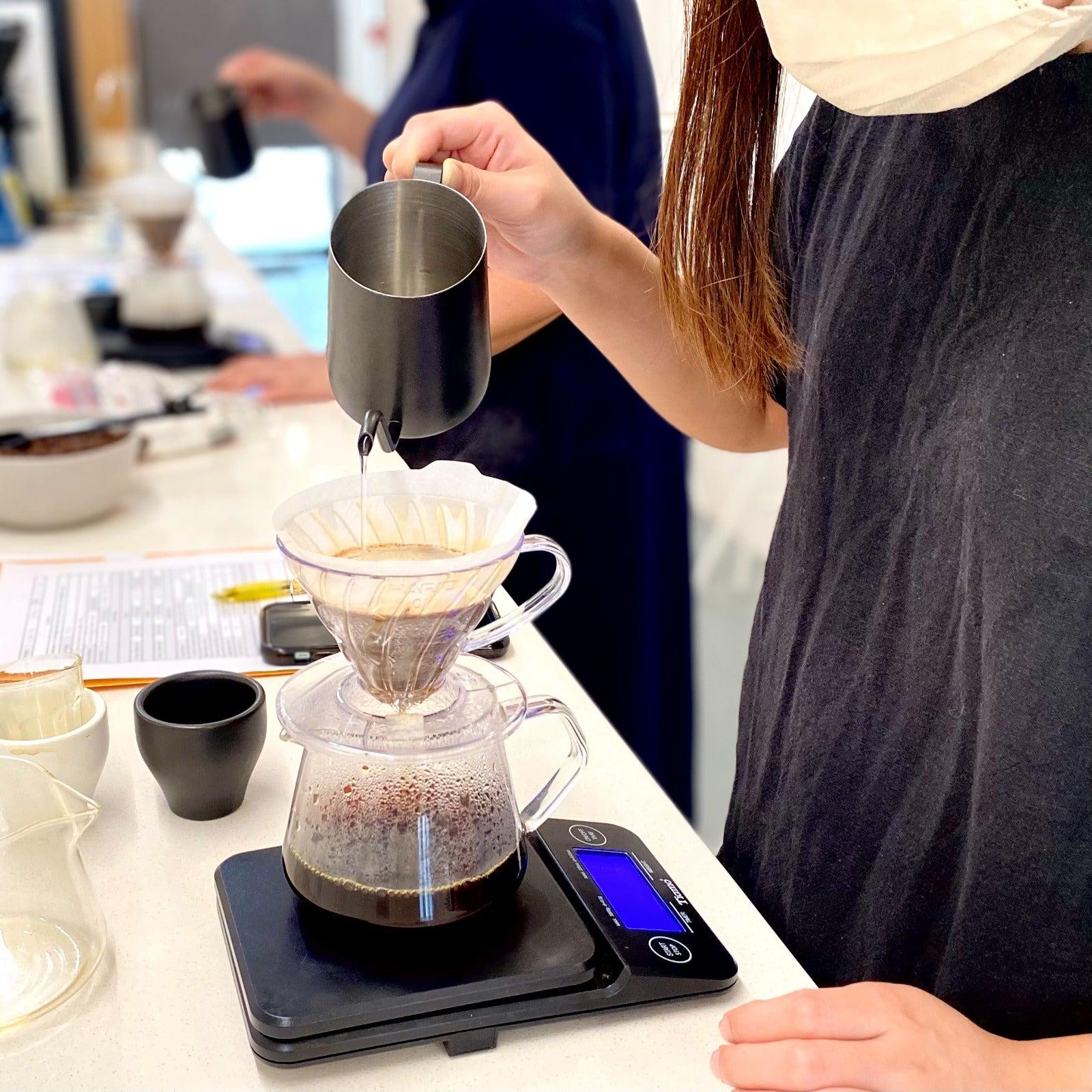
A coffee scale makes brew ratio much easier to control.
Instead of measuring coffee and water by volume, you can measure both by weight.
For example:
20 g coffee + 320 g water = 1:16
This is more precise and repeatable than estimating water by cups or coffee by spoons.
A scale is particularly useful when testing a new coffee because even small changes in the recipe can affect the final cup.
For home brewers, one simple approach is:
-
Weigh the coffee.
-
Measure the brewing water by weight.
-
Record the ratio.
-
Brew the coffee.
-
Taste the result.
-
Adjust one variable at a time.
How to Adjust Brew Ratio Based on Taste
Your palate is the most important guide.
If the coffee tastes too strong or concentrated, you can try using more water.
For example:
1:15 → 1:16 → 1:17
If the coffee tastes too weak or diluted, you can try using less water.
For example:
1:17 → 1:16 → 1:15
But remember that strength is not the only thing to evaluate.
Also pay attention to:
-
Sweetness
-
Acidity
-
Bitterness
-
Body
-
Clarity
-
Aroma
-
Aftertaste
-
Overall balance
The goal is not simply to find a stronger or weaker cup.
The goal is to find a balanced expression of the coffee.
Brew Ratio for Different Coffee Styles
Different coffees may benefit from different approaches.
Light Roast Arabica
Light roasted Arabica is often brewed with enough water to highlight acidity, sweetness, floral notes, and clarity.
A ratio around 1:15–1:17 can be a useful starting range, depending on the coffee and brewing method.
Medium Roast Coffee
Medium roasted coffee may work well across a broad range of ratios.
A moderate ratio can help balance sweetness, body, acidity, and roast character.
Dark Roast Coffee
Dark roasted coffee can be more soluble and may produce a strong flavor quickly.
Some brewers prefer using a higher water ratio to create a more balanced and less intense cup.
These are only general starting points.
The actual recipe should always be adjusted according to the coffee itself.
Brew Ratio and Cau Dat Arabica
Cau Dat Arabica from the Da Lat highlands can be brewed in many different ways.
Depending on variety, processing method, roast level, and brewing technique, the same origin can produce different sensory experiences.
For example, a washed Cau Dat Arabica may highlight clean acidity, sweetness, floral notes, or fruit characteristics when brewed with a recipe designed for clarity.
Rather than searching for one “correct” ratio, it can be more useful to experiment systematically.
Start with a consistent recipe.
Then change the ratio slightly and taste the difference.
This allows you to understand how the coffee responds.
A Simple Brew Ratio Experiment
Want to understand brew ratio for yourself?
Try this simple experiment with the same coffee.
Use:
20 g coffee
Then brew three separate cups:
Cup A
20 g coffee + 300 g water
1:15
Cup B
20 g coffee + 320 g water
1:16
Cup C
20 g coffee + 340 g water
1:17
Keep everything else as consistent as possible:
-
Same coffee
-
Same grind size
-
Same water temperature
-
Same brewing method
-
Similar brewing technique
Then taste the three cups side by side.
You may notice differences in concentration, body, sweetness, acidity, and clarity.
This simple comparison is one of the easiest ways to understand what brew ratio actually does.
Final Thoughts
Coffee brew ratio is one of the simplest concepts in coffee brewing, but it can have a significant influence on the final cup.
It describes the relationship between coffee and water and provides a practical starting point for creating repeatable recipes.
But there is no universal perfect ratio.
Every coffee has its own characteristics, and factors such as roast level, grind size, water temperature, brewing time, processing method, and extraction can all influence the result.
The best approach is simple:
Measure → Brew → Taste → Adjust.
Start with a consistent ratio, make small changes, and let the coffee guide you.
For roasters and coffee buyers, understanding how coffee responds during brewing is another important part of evaluating quality — from the green bean all the way to the final cup.
Discover Vietnamese Coffee with Cau Dat Bean
Cau Dat Bean supplies selected Vietnamese coffee from the Da Lat highlands, including Arabica from the Cau Dat growing region.
We work with different coffee varieties and processing methods for roasting, wholesale, and export.
Cau Dat Bean Showroom
82B Trương Công Định, Phường Xuân Hương, Đà Lạt, Lâm Đồng, Vietnam
Phone / WhatsApp: +84 926 915 849
Email: caudatbean@gmail.com
Try before you buy.
Frequently Asked Questions
What is a coffee brew ratio?
Coffee brew ratio describes the relationship between the amount of coffee and the amount of brewing water, such as 1:15 or 1:16.
What does a 1:16 coffee ratio mean?
A 1:16 ratio means using 1 gram of coffee for every 16 grams of water. For example, 20 g of coffee with 320 g of water.
Is 1:15 or 1:17 better?
Neither is automatically better. A lower ratio generally produces a more concentrated beverage, while a higher ratio produces a more diluted beverage. The best choice depends on the coffee and your preferred taste.
Does brew ratio affect coffee extraction?
Yes, brew ratio influences brewing conditions, but it should not be confused with extraction yield. Grind size, time, temperature, and other variables also affect extraction.
Should I use a coffee scale?
A scale is highly useful because it allows you to measure both coffee and water accurately and repeat the same recipe more consistently.


 Group4, Cau Dat Village, Xuan Truong commune, Da Lat City, Lam Dong Province, Vietnam
 +84 783 472 234
 caudatbean@gmail.com
  www.caudatbean.com